Tag Archives: sermons

Living in the Freedom of Christ in the Year 2024

Sermon for New Years’ Eve -12/31/2023

Rev. Enzo Pellini

Galatians 4:4-7

4 But when the set time had fully come, God sent his Son, born of a woman, born under the law, 5 to redeem those under the law, that we might receive adoption to sonship.[a] 6 Because you are his sons, God sent the Spirit of his Son into our hearts, the Spirit who calls out, “Abba,[b] Father.” 7 So you are no longer a slave, but God’s child; and since you are his child, God has made you also an heir.

***

“Grace and peace to you from God our Father and the Lord Jesus Christ, who was, who is and who is to come”. Amen

Today is the last day and, at the same time, the last Sunday of the year 2023. A year that will never return. Although we know that there is no real difference between 2023 and 2024, for us, today marks a point of change. There are many things we ponder, such as what the new year will be like, the new 12-month period we will call 2024. How will it go for us? Will it be good or bad? What difference will it make for us, who are Christians and followers of Jesus Christ? For us, who want to trust in Christ, even in this new period.

Let’s consider New Year’s resolutions, which almost always fail. Robert Maurer, in his book “One Small Step,” a book I recommend, says: “The average American makes the same resolution for ten consecutive years without success. In the next four months, 25 percent of resolutions are abandoned. And those who succeed in keeping their resolutions usually do so after breaking them five or six times in a year.”

What are your New Year’s resolutions? I’ll tell you, according to this book, 3 out of 10 resolutions are abandoned within the first four months. Why? Because they demand too much from people all at once. The brain is not prepared for drastic changes; it sends a signal to the body to protect itself. Drastic change is interpreted as a danger by the brain. So, one must know how to trick the brain, and that’s what the book is about.

The same happens in our Christian life. Surely, many of us want to start living a true life in Christ. Or we want to say that we hope God blesses us in this new year, or we simply hope things go well for us in this year. How can God bless us in this new year? Only if we have a good fellowship with God. If we are truly in communion with Him. But how to achieve fellowship if I always fail, can’t fulfill His commandments?

It happens in our Christian life almost like with New Year’s resolutions. We are not able to fully comply with God’s commandments. So, what is the solution to have a true communion with God so that He can truly bless us in 2024? And it’s almost like what this book suggests, only through small steps.

The first small but significant step we must take is to surrender our lives to Christ through a spiritual decision. Truly say to Him: “Lord, I want to start living my life in 2024 truly believing and trusting in You. I want to believe in You and surrender my life to You.” It’s a decision of the heart. I also know that I cannot trust 100%, even if I intend to. I know I cannot fulfill 100% of Your commandments, even if I intend to. But You tell me to feel free, not a slave to Your laws but free because I don’t need to be perfect to attain salvation. What I need is to be honest and humble, acknowledge my sins, vulnerabilities, failures, and, even with the sincere intention to live my life according to Your will, admit that I cannot do it alone.

That’s what living in a family relationship with God is about. Not as a master to a slave, but as a father to a son, or a mother to a child. Today, the apostle brings an interesting comparison with the word “Abba,” the term Jesus used for His Father, Abba. What does Abba mean? It’s Daddy. How do you call your parents or used to call them? If you haven’t had a good relationship with your father, we can imagine with your mother, for illustrative purposes. I still call my father “Daddy,” (Papi) and my mother “Mommy.” (Mami) My children don’t call me Enzo; they call me “Papi.” Why? Because it’s an affectionate way to address the father, or mommy to the mother, demonstrating a relationship of affection and trust. Similarly, if we can call our God as we call our parents, it means we have a true relationship of affection, love, and trust. God is not a master of a slave but someone with whom we have a relationship or communion. It means that God is by our side; we can talk to Him and trust Him. Why can we trust? Because a relationship of intimacy has been established. God is our friend, beyond our imperfections. God knows our shortcomings, our sins, but still understands us, forgives us, and gives us new strength to continue. That’s what it’s about, as I’ve been preaching many times this year, starting to have a true fellowship based on our honesty and sincerity with God.

“So you are no longer a slave, but God’s child; and since you are his child, God has made you also an heir.” The apostle Paul is explaining that, through faith in Jesus Christ, people cease to be slaves to the law and become children of God, heirs of His promises and blessings. This message emphasizes the importance of a personal relationship with God based on grace and love, in contrast to living under the regime of the law. Before the arrival of Christ, all people had to fulfill the laws of Moses, which are now part of our Old Testament, to be faithful believers. The only way to be considered a true faithful child of God with the possibility of obtaining eternal life was to faithfully fulfill the law, especially the Ten Commandments. In other words, the more obedient, faithful, or holy we were, the more God would love us, and we would receive everything He promised. The less we complied with the law, the fewer chances there were for God to love us and for us to obtain salvation.

What Christ brought differently is that God saves us through our faith and surrender to Him, primarily not based on our merits, sacrifices, or perfect compliance with commandments. Jesus Christ interceded before God, took on the sins of the world so that God the Father would have mercy on humanity. The only condition He asks of us is to love Christ, accept that He is the Son of God, and that whoever believes in Him shall not perish but have eternal life. That is the message of the good news we spoke of last Christmas Eve. And that is what will liberate us completely. And also, if there are people who still don’t know, what will free us to live a year 2024 free, no longer enslaved to law compliance but free because we know that God loves us simply because He is good and wants to give us salvation. We don’t have to make a special sacrifice or superhuman efforts to attain His love and obtain salvation; the only condition, however, as I said, is to accept and believe in Him and surrender our lives to Him.

Now, let’s consider how this message of freedom and new life relates to the New Year’s resolutions we often make. Just as we recognize our inability to fully comply with the law, we also face the reality of our New Year’s resolutions that sometimes fail. Self-sufficiency leads us to set unrealistic expectations, resulting in frustration and disappointment. Today, God asks us to stop considering ourselves self-sufficient and to place all our trust in Him. Let’s put the entire year 2024 with all the fears, insecurities, and worries it may bring, and surrender our lives to Him so that He may work. We are His children, and as children, He wants to take care of us throughout this year according to our surrender to Him. Martin Luther stated, “Care and effort do not go against faith, but worry goes against God.”

May God give us, in this sense, a wonderful and fruitful year, in God’s terms. And may we truly succeed in our New Year’s resolutions for 2024 to have a true communion with Him. The quality of the new year 2024 will depend on that relationship.

May the grace and peace of our Lord Jesus Christ be with you in this new year.

In the name of Jesus, Amen.
Protected by God We Can Witness

Rev. Enzo Pellini
Luke 8:26-39
 
26 Jesus and his disciples sailed to the area of the Gerasenes across the lake from Galilee. 27 When Jesus stepped on shore, he was met by a man from the town. The man was controlled by demons. For a long time he had not worn clothes or lived in a house. He lived in the tombs. 28 When he saw Jesus, he cried out and fell at his feet. He shouted at the top of his voice, “Jesus, Son of the Most High God, what do you want with me? I beg you, don’t hurt me!” 29 This was because Jesus had commanded the evil spirit to come out of the man. Many times the spirit had taken hold of him. The man’s hands and feet were chained, and he was kept under guard. But he had broken his chains. And then the demon had forced him to go out into lonely places in the countryside.
 
30 Jesus asked him, “What is your name?”
 
“Legion,” he replied, because many demons had gone into him. 31 And they begged Jesus again and again not to order them to go into the Abyss.
 
32 A large herd of pigs was feeding there on the hillside. The demons begged Jesus to let them go into the pigs. And he allowed it. 33 When the demons came out of the man, they went into the pigs. Then the herd rushed down the steep bank. They ran into the lake and drowned.
 
34 Those who were tending the pigs saw what had happened. They ran off and reported it in the town and countryside. 35 The people went out to see what had happened. Then they came to Jesus. They found the man who was now free of the demons. He was sitting at Jesus’ feet. He was dressed and thinking clearly. All this made the people afraid. 36 Those who had seen it told the others how the man who had been controlled by demons was now healed. 37 Then all the people who lived in the area of the Gerasenes asked Jesus to leave them. They were filled with fear. So he got into the boat and left.
 
38 The man who was now free of the demons begged to go with him. But Jesus sent him away. He said to him, 39 “Return home and tell how much God has done for you.” So the man went away. He told people all over town how much Jesus had done for him.
 
***
Today we are once again touching on a topic that has to do with the spiritual aspect or the spiritual dimension. Last Sunday we talked about the Holy Spirit and the Trinity, as the invisible reality of God. Today we talk about invisible and spiritual things as well, but in this case, they do not have to do with the things of God, but rather with Satan.
 
It is a little bit complicated nowadays to talk about Satan, or the devil, or the demon, in our highly materialistic and scientificist society that wants nothing to do with the spiritual or non-visible dimensions. And at the same time with a society so proud of the technological and scientific achievements of the human being, where many believe that this already surpasses everything that has to do with what is not measurable or not scientifically verifiable, call it faith and all spiritual things.
 
For me as a pastor, it is difficult many times to have to preach these topics, because we are dealing, as I said, with this situation. And even sometimes it is also difficult and sad to have to see how there are even preachers who do not believe in this biblical reality at all and seem to stand on the same ideas as non-believing society, even sometimes ridiculing or belittling the aspect of faith and spirituality in other ministers.
I have even known preachers who deny this aspect, emphasizing that the essence of Christians should only be to help socially as an exercise of neighbourly love, (which is very good, that is the second part of the Greatest Commandment; Mt 22:37-40) but they forget the first part, that is worshiping God in spirit and in obedience to his Word. And so many churches even come to not distinguish at all from a social assistance work, for example.
But as on every Sunday I will try to preach the message that has been entrusted to me.
 
Today’s story leads us to a wild and indomitable man who was possessed by a legion of demons. And what we will notice is that the Lord Jesus Christ has full dominion over this issue. Not only at that time, but he has it now in our days as well.
Of course, this demoniac was an extreme case, but nonetheless, it is a warning of what it would mean for human beings to perish under the power of sin and Satan. And this will be so, unless they are delivered by Christ (Eph 2:2) (Col 1:13).
 
Once the demons left the man, the change was radical. Now he was with Jesus “He was sitting at Jesus’ feet. He was dressed and thinking clearly.” No one had dreamed of getting anything like this from this man. And it is that the power of the Lord Jesus Christ reaches where neither the government, nor social workers, nor psychiatrists, nor family, nor friends can reach. Nobody before had managed to make this man at peace with himself and with his fellow people.
 
The same thing happens today. There are people who, like the possessed person in the story, end up in that state, and there are others who, to a lesser degree, also have similar problems.
 
The gospel inform us of the fact that a person can be enslaved by more than one demon at the same time (Mt 12:45) (Mk 16:9), but this case is unique. What is it trying to teach us?
In the same way that the Roman Empire had managed to conquer Israel through its legions, (each legion comprised of an absolute total of 10,000 soldiers) this miserable man was totally occupied and dominated by the demonic forces that kept him in a situation of oppression and death. We note then that the purpose of the devil towards the human being is of a military type: ‘to conquer and dominate’. That is, getting away from fellowship with God, getting away from church, getting away from Sunday worship, getting away from the sacrament with brothers and sisters, getting away from daily personal devotion, through our prayer, our reading of the Bible, our praise, everything that truly builds and strengthens our own spirit. In this way the devil manages to have a spiritual control over our being that makes us unable to feed our spirit through the means of grace. This, over time, makes us weaken spiritually and completely and also physically, because the spirit has control over our entire being.
 
How do we feel when we hear this words? Do we accept it or do we reject it? This is part of our spirituality. In the same way that we preach and confess the Holy Spirit, and say “I believe in the Holy Spirit” as the invisible presence of God, in the same way we have to be aware that the Bible teaches us too: Put on all of God’s armor. Then you can remain strong against the devil’s evil plans.  Our fight is not against human beings. It is against the rulers, the authorities and the powers of this dark world. It is against the spiritual forces of evil in the heavenly world. (Eph 6:11-12)
 
What does this mean? What does it mean to put on the armor of God? You see that here again, now the apostle in the New Testament, uses military language, he says armour. An armour was used in ancient times to protect oneself, in a hand-to-hand fight.
Why Satan wants to fight? Because he wants to destroy us. He wants to destroy the fellowship we have with God. And our question this morning: How can we best resist the devil in this 21st century world? Resisting the devil in the best way is as Martin Luther also tells us in still updated words: “The word of God and prayer are the best weapons. Whoever serves these, the angels will be by their side.
 
At Christmas, every year, we like to represent the Christmas scene and include angels in it. The children dress as angels. The angels existed and exist, they are a reality. Angels behave mostly as messengers of God, sometimes as protection, spiritual beings of God. If angels exist, they can help us because they are sent by God, we know that they are spiritual beings who, as they please, can make themselves visible as well.
In the same way there are spiritual beings that are not of God that we call evil spirits or demons. Those are the ones who desperately asked to get out of the body of the demon-possessed when Jesus stood in front of them. Those also exist.
How significant it is that when many times in our society there are many who deny or ridicule the belief in God, in Jesus, in the spiritual, in the Bible, according to the story, the same demons, instead, did recognize Jesus as the Son of God. That is one more proof of the existence of God and Christ and of the spiritual world.
 
“Return home and tell how much God has done for you.” So the man went away. He told people all over town how much Jesus had done for him.
This is what Jesus said to the exorcised, to the restored, to the healed.
We are healthy, restored by Christ, badly or well we want to take care of our fellowship with God, because it is the only thing that will fully hold us.
We strive, with our strengths and with our weaknesses, we do our best. Jesus calls us to take care of that fellowship with him. And tell others about our struggles, but also about our new life in Christ and the protection we make of our faith in Him before an indifferent or unbelieving world.
 
Amen.

My Sheep Listen to My Voice

Sermon for the Fourth Sunday of Easter-05/08/2022
Rev. Enzo Pellini
John 10:22-30
Then came the Feast of Hanukkah at Jerusalem. It was winter. 23 Jesus was in the temple courtyard walking in Solomon’s Porch. 24 The Jews who were gathered there around Jesus spoke to him. They said, “How long will you keep us waiting? If you are the Messiah, tell us plainly.”

25 Jesus answered, “I did tell you. But you do not believe. The works that I do in my Father’s name are a witness for me. 26 But you do not believe, because you are not my sheep. 27 My sheep listen to my voice. I know them, and they follow me. 28 I give them eternal life, and they will never die. No one will steal them out of my hand. 29 My Father, who has given them to me, is greater than anyone. No one can steal them out of my Father’s hand. 30 I and the Father are one.” (NIrV)


One of the most important questions that I’d like to have clearly answered for every one of us is: why do we need a church? If we can leave the service today with this question clearly answered, then we can say that we are able to understand what does it mean to be Jesus’ flock.

Jesus says: “My sheep listen to my voice; I know them, and they follow me…” God will never allow a church to be founded in His name nor will he ever allow a church to continue to grow if it is not founded by His sheep and still being filled by His sheep.
Being a sheep means, among other things, that we are owned by Christ. We hear his voice; this means we recognize; we accept, we believe and we try to obey that voice. And there is something very important about following: that is to keep near to the master, in this case, Jesus. If we use Jesus’ comparison of the sheep, we can we see that the church is a flock of sheep and that Jesus is the shepherd.
If each one of us that comes to church considers oneself to be part of the church of Jesus, then each of us will recognize Jesus as God, Lord, Savior, Messiah, Son of God and Creator of heaven and earth. If this is so, then we are following Jesus and we hear his voice.

If every one of us that comes to church accepts Jesus, that he is our savior and Redeemer and that what he tells us through His word is the highest authority that rules my life, then we are following Jesus.
If every one of us that comes to church truly believes that the Bible is the word of God, and that Jesus is talking daily through our reading of it, then we are following Jesus.

If every one of us makes a daily, at least humbly effort to want to please Jesus, then we are following Jesus.

The church is the body of those people who recognize, accept and believe in the voice of Jesus and follow him. If you belong to those sheep and consider yourself within that flock, then of course you’re one of Jesus’ sheep. Even though you may sometimes make mistakes, be wrong, sin, or have moments of weakness and sadness and lack of faith or distress. But in short, when it counts, you act like God would like. Do not worry; we all go through the same problems and tests. It is most important that you clearly love Jesus though.
If you love Jesus, then I have to declare that you belong to his flock; you are one of those sheep. Then feel good and say out loud, I follow Jesus and belong to his flock! despite my flaws. That’s the most important thing that you are able to declare this and believe in this.

The second most important of being part of the flock is when Jesus says: “I give them eternal life, and they shall never perish; no one will snatch them out of my hand.” (NIV) That is something that many who are considered part of Jesus’ flock are slow to acknowledge, or are still in doubt as to whether this can be true. And that happens because of our lack of trust in God.

Our life on earth is temporary; that is not a mystery. Yet God can grant us a happy and blessed life if we confess aloud the blessings from God that we do have and thank God every day for what he gives us. Our life on earth can be sad and unhappy or happy and cheerful; it mainly depends on us, our thoughts, our way of talking or feel and, of course, our confidence in God. God promises to give us a life on earth and have it in the fullest possible way. But for this we also have to do our part – be accountable of our thoughts, words and actions.
Still, despite having been able to live an abundantly life in this life, death still awaits everyone, Christians and non-Christians alike, and there Jesus promises eternal life to his sheep, the Christians. He will give us paradise and I won’t need to explain how great it will be because you know it. But one of the most beautiful declarations today is that he tells us: “No one will snatch them out of my hand.” And that’s a message for us today.
Everyone one of us who belongs to this Redeemer congregation and each one of those who belongs to every church in the world that confesses Jesus Christ is protected, is anointed, is favoured, is blessed and is cared for by God the Father, Son and Holy Spirit. Every one of those is considered part of Jesus’ flock of sheep. We are accompanied by God on this earth and in the life beyond.

And this is something, dear sisters and brothers, that we should not lose sight of. The Redeemer Lutheran Church is not a building. Buildings can exist today and be gone tomorrow. But if people who congregate in a certain building are part of Jesus’ flock, nothing and nobody will harm them. Nothing and nobody can defeat them. No demon, nor foe, nor any vicious or poisonous or negative tongue or gossip may destroy them. This is so because the church is anointed by the power of Jesus Christ, the anointed one. And that’s the most important thing that we have to recognize now: our church is armoured by the power of God’s Holy Spirit. And if each one of us helps so that the word of God is proclaimed in this church for all who are hungry and thirsty for the message of hope and truth of Christ, then the church will remain, grow and strengthen and that is a truth that is supported by the holy word of God. And those who do not think this way won’t be able to belong to his flock. They won’t be worthy of belonging to his flock because they do not believe in his word. If you really are a sheep of God, then you must believe in His word and His word tells us today that there is a shepherd who is Jesus Christ. He wants to take care, He wants stay, He wants to bless us, He wants to multiply us and He wants to see us grow only for His glory.

In the Bible, there is a very important verse with which I made a great discovery in my spiritual life: “Without faith it is impossible to please God, because anyone who comes to him must believe that he exists and that he rewards those who earnestly seek him.” (Heb 11:6) And there I felt in a subtle but powerful way that we must show faith. Faith is not an option; faith is not some kind of illumination that we will receive in a special way, like a manifestation some day, as in Pinocchio’s fairy tale. No fairy will wave her wand and fill us with faith. If we wait for this, we can live a lifetime and never become faithful. Faith begins as an act of will. We decide to have faith.
When we decide to have faith in this way it is because we want to please God and we want to follow God. In return, God will begin to bless us in a supernatural way, and this is His way. We already have the natural way but He gives us the supernatural. If we want to please God, then we have to believe in Him. He tells us today: “I give them eternal life, and they shall never perish; no one will snatch them out of my hand.” So, if you love God today, you have to believe. And it is not a question of can, but of want. If you believe you are not only loving Him but also obeying him.

Jesus is promising us today, even though these words are universal for all churches and times, that we members of the Redeemer Lutheran Church: “He gives us eternal life, and no one will snatch us out of His hand,” That’s God’s promise for us today. I invite you today to start to believe, to take that ‘leap of will’, to not follow feelings or wait for magical things. Take that step of will and God will add the lacking faith. He is not only going to bless this church, but He is going to bless you and your family as well from now on.

And now I’d like to come back to the original question: why do we need a church? The church is God’s way of communicating and blessing. The church is the place where we pick up strength for the week. The church is the place where we come to worship God on the day of rest. Sometimes God only wants our presence, nothing else and nothing special. That is obedience. God cannot bless if, even if He would love to, if we are not following Him. God wants us to follow Him; he wants our commitment, even with our faults, doubts and weaknesses. If you’re wondering why God does not bless you as you wanted, I wouldn’t say that we have to blame him. The church is the only way that God has to speak to us through His word and sacrament and show His love as when he tells us: “For where two or three gather in my name, there am I with them.” (Mt 18:20) Do not lose sight of this because here there can be the answer to your questions and the beginning of a new life for you.
Amen.

Worshiping Him Is the First Step of Faith

Palm Sunday-04/10/2022
Rev Enzo Pellini
Luke 19:28-40


Palm Sunday is a festivity. It may sound weird a celebration in the middle of Lent for those who still do not know the meaning of our church year. Yes, it is a celebration because Jesus won, he is alive. It is the beginning of his victory on his way to the cross to defeat the devil and death. He is now in our midst alive, risen and in power.
It is a celebration in praise of God where we express our joy in God because he is shown himself as our king, our sovereign, our God. All those who believed his message during the three years of his ministry were now praising Jesus as the Son of God, the King and the Messiah. With the day that we call Palm Sunday, as we read in the Gospel, a period ends in the ministry of Jesus and another begins in the life of humanity.

Jesus was a human being and came to us as a mere man in order to reach us in a more understandable way. However, while he was incarnated in a human body, his Spirit was the Spirit of God. He lived as a man physically, but inside he was God. His mission was to tell the world that he had been sent by God to bring a message of hope, happiness and salvation. This was the message: All those who accept that God sent his Son into the world and choose to believe in God through him and accept that he came to sacrifice his life to give us salvation, will be considered saved and part of God’s flock.
This statement is very simple to understand, if indeed we accept it by faith or it can be very difficult and intricate if we see it with critical human eyes. This is not something we’re going to understand humanly, so you are free to accept it or not. It is only up to you and your faith in the gospel message.

The church is not an association or club, nor a civil organization or a company, nor a charity or aid organization. The church is not a philanthropic society; the church is not an ethnic entity or secular society. The church is a building itself, where those who profess faith in Jesus Christ come together to worship and praise His name. We meet to share His Word that is only registered in the book we call the Bible and it is our supreme authority. We come to church to seek His help. This help is not human. We come to seek divine help, that is, God’s help. When we pray, we are showing that we believe in Him. People who do not pray still do not believe in God. People who cannot pray have not accepted to believe in Jesus Christ as God and Savior. It is impossible to say that I am a Christian if I cannot pray to God. That’s a good sign to know if I am a Christian: Am I praying to God? Do I have a prayer life, a daily communication with God? If not, then there is an issue in my life of faith. There is something that is not complete in our spiritual life.

We can say that Palm Sunday brings to an end the time of preaching on earth for Christ. People no longer refer to him as a man, prophet or teacher. People praise him and pray to him and regard him as God. During this Holy Week there is the suffering, which we also call ‘passion’. For Christ suffers. Here begins Christ’s sacrifice. Jesus sacrificed for us. This is somewhat difficult to understand: why would he sacrifice himself? What for? These are difficult questions to answer. Even the greatest theologians could not answer them properly. But there is something we do can with our human nature: believe in it. God does not ask us difficult things. God does not ask you to become a theology professor or wise and all-knowing. All God asks for is your faith and commitment to him. That is the first step of faith.

This Easter I want to bring a simple, yet challenging, message. It is the same message Christ delivered throughout his ministry:
How is our life? Do we believe in Christ as the Son of God? Or do we still have doubts? How is our life? Do we believe that God died on the cross for us? How is our life? Do we agree that God is a loving God who only wants to fill our life with love and forgiveness? How is our life? Do we put our faith and trust in Christ, as he is God? How is our life? Do we pray to God daily or are we not able to pray and or do not know what that is or how to do it? Could we answer these questions in a positive and clear way? If we truly want to be a Christian, we have to meditate on these questions. God wants to change us. And the change that we need to make begins with our own spirit.

In this Holy Week, there may be a unique opportunity for us to see that we’re here today, in this building, not because of custom, even though you may have come here for many years. We’re in this building because it is a church. And I always like to explain to the confirmands the meaning of the word church. The word church comes from the old English “Kirk”, this in turn from the Greek word “Kyrios” which means “Lord”. That’s why we say the day of the Lord. We go to the place where we remember the day of the Lord. And here is when we call upon God the Father, Son and Holy Spirit. God himself is present and wants to be praised, wants to be glorified, wants us to sing to him, wants us to read His word and, above all, wants us to believe in him and have a life of prayer. Surely, he is awaiting an answer from us in this season.

If our life is full of faith and reverence for him, surely you have a Bible in your house and open it every day, though you often do not understand much. And that’s obedience and faith. Surely, you are placing your life in God’s hands with confidence. That’s obedience and faith. Surely you pray in your own simple words daily. That’s obedience and faith. Surely you love your church and try to put it in the first place. That’s obedience and faith. If you are living that way and those things happen in your life then rejoice because you are sincerely praising God in the same manner as those people who praised him on Palm Sunday, even though you have not lived with Him and you could not wave palm branches before Him. But if you are waving branches with your heart, he will love you and bless you for that every day of your life.

Being a Christian is about other things too. When the second part of Great Commandment tells us: “Love your neighbor as yourself.” We are saying that we should love and help specifically and materially with work, money, help, love, affection and solidarity. We should do all of these works of love but we must remember to not overlook the fact that, first of all, all this must come after having praised, worshiped and glorified Jesus Christ as our Lord and Savior, as our king. For deeds done for God are worthless if they are not done firstly out of our gratitude and on his name. That is the mystery of the gift of salvation, of the priority of our faith and worship to him.

God wishes our worship. For Him is the very first thing.
Praising God means expressing worship through our own spontaneous prayer to God, with our joy, for he is our God and we come to a church for worshiping. When we worship, we are allowing him to come into our lives. If we can understand that and do it, God will begin to answer those things we still are not seeing answered in our lives.
And finally, I’d like to tell a nice but real story about the true meaning of putting our worship and trust in God first:

Around 1814, the citizens of Feldkirch, Austria, didn’t know what to do. Napoleon’s massive army was preparing to attack. Soldiers had been spotted on the heights above the little town, which was situated on the Austrian border. A council of citizens was hastily summoned to decide whether they should try to defend themselves or display the white flag of surrender. It happened to be Easter Sunday, and the people had gathered in the local church.

The pastor rose and said, “Friends, we have been counting on our own strength, and apparently that has failed. As this is the day of our Lord’s resurrection, let us just ring the bells, have our services as usual, and leave the matter in His hands. We know only our weakness, and not the power of God to defend us.”

The council accepted his plan and the church bells rang. The enemy, hearing the sudden peal, concluded that the Austrian army had arrived during the night to defend the town. Before the service ended, the enemy broke camp and left.

More than ever on Palm Sunday, God comes to ask us to remember that he expects from us praise, worship and glory as part of our fellowship with him.
The peace of God, which transcends all understanding, will guard your hearts and your minds in Christ Jesus. Amen

Genuine Surrender

Sermon for the 5th Sunday in Lent
Rev. Enzo Pellini
John 12:1-8
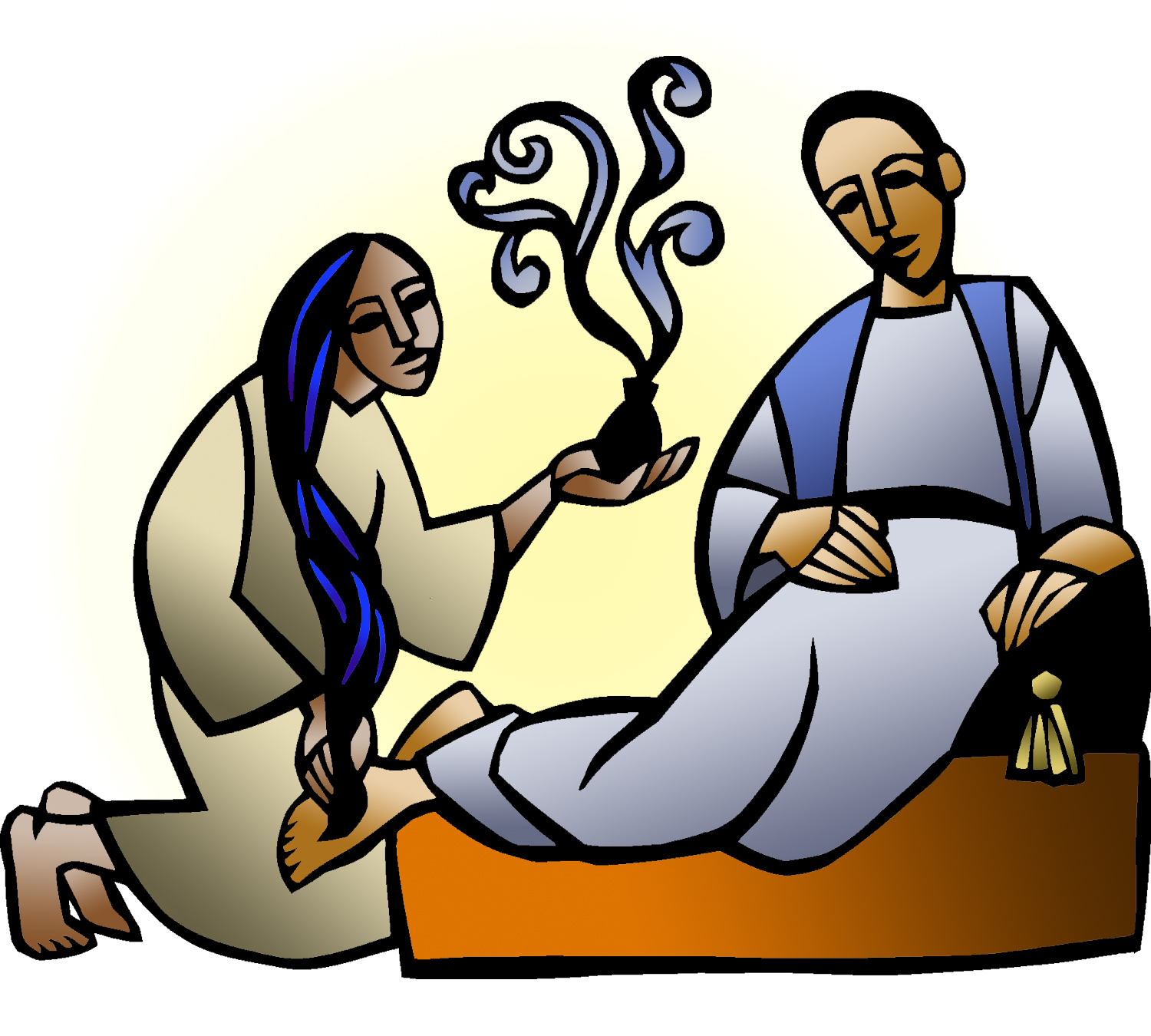
It was six days before the Passover Feast. Jesus came to Bethany, where Lazarus lived. Lazarus was the one Jesus had raised from the dead. 2 A dinner was given at Bethany to honor Jesus. Martha served the food. Lazarus was among the people at the table with Jesus. 3 Then Mary took about a pint of pure nard. It was an expensive perfume. She poured it on Jesus’ feet and wiped them with her hair. The house was filled with the sweet smell of the perfume.

4 But Judas Iscariot didn’t like what Mary did. He was one of Jesus’ disciples. Later he was going to hand Jesus over to his enemies. Judas said, 5 “Why wasn’t this perfume sold? Why wasn’t the money given to poor people? It was worth a year’s pay.” 6 He didn’t say this because he cared about the poor. He said it because he was a thief. Judas was in charge of the money bag. He used to help himself to what was in it.

7 “Leave her alone,” Jesus replied. “The perfume was meant for the day I am buried. 8 You will always have the poor among you. But you won’t always have me.”


Today’s Gospel shows us how important it is to be able to imitate a model way of gratitude and love for Christ such as that shown by Mary of Bethany.

Our tradition invites us to remember the passion and resurrection of Jesus in this season that we call Lent with Holy Week and Resurrection Sunday. Today we are invited to understand and appreciate the work done by Christ on the cross. Many of us are not fully aware of the greatness of this event. Only the Holy Spirit can give us a true understanding of what it means that Jesus died on the cross for us. Although if we may not fully understand it, don’t worry, the most important thing is that we can say: – “Thank you Lord for your redeeming work on the cross and thank you for allowing me to believe in you as the risen Son of God, present and alive in my life. I adore you and praise you for it.” That is what it is all about every time we want to celebrate the season of Lent, we want to value the redemptive work of Christ on the cross and be willing to teach others what he did through the good news and our testimony of faith, and invite them to believe in Him to may they too attain salvation.

Mary of Bethany, if you remember, she was the one who sat close to Jesus and she wanted to hear his word every time he came home. You may remember the story of Mary and Martha. Martha was the industrious sister who wanted to serve Jesus with her food and Mary with her attentiveness. Mary was the sister of Lazarus, the man that Jesus had resurrected. And the twelve disciples were probably also there in the house of the three siblings because it is mentioned that Judas was there, who would later betray Jesus.

When we quickly read this story, it may not touch us too much, a woman who poured expensive perfume on the feet of Jesus, what a beautiful gesture, we may not feel the dimension of this. That is why I would like to give some more data. The plant of nard grows between 3,000 and 5,000 meters in the Himalayas of Nepal, as well as in northern India and China. 70 plants are needed to extract a small amount of perfume from the roots. The Hindus used it as medicinal oil and for perfume. Owning pure perfumes like nard was a form of investment in those days. Let us remember that at that time there were no banks like today, nor sophisticated safes and a way to invest or save money was through other goods such as fabrics, perfumes and for the richest silver and gold coins. It is certain that this perfume will have come from Mary’s savings. It says in the Bible that the amount that she poured was worth 300 denarii. The denarius was a Roman coin. They used the currency of use in those days, as today we might use US dollars, for example, it was a common exchange currency. A denarius was equivalent to one day’s pay for a day labourer. A day labourer worked throughout the Roman day, which went from sunup to sundown from 6 in the morning to 6 in the evening. If we could convert the worth of a denarius to today’s value in Canada, we could say that it is the equivalent of $120 CAD, if we only calculate an 8-hour labour day. This tells us that 300 denarii are $36,000 CAD. That was the value of the perfume that Mary poured.
Mary poured these three hundred grams (or millilitre) of perfume on the feet of Jesus as an offering or reverence.

Why perfume? Why do we perfume ourselves both men and women? What is the meaning of this? Or why do we use fragrances, air fresheners or incense burners to give our homes a pleasant smell? Because smell, like the other five senses, is also an important aspect of our lives. We want what others smell of us to be pleasant. Good smell or fragrance denotes beauty, cleanliness and therefore appeal. In the same way, pleasant smells denote purity, beauty and a feeling of pleasure, peace and happiness. These feelings are also reflected through our sense of smell. The pleasant smells that perfumes and essences give off are appreciated and valued because they make us feel good and give us happiness.
That is why the more durable, strong and pleasant to smell the perfumes are, the more appreciated and expensive they are. There are perfumes so expensive today that a bottle may cost upwards of $5,000 CAD.

The bottle of perfume that Mary poured represented not only her savings or money, but part of her life, her total surrender to God. To show true worship and praise that jar had to be poured or donated to God. This woman who pours out all her values in an instant wants to show her devotion and total trust in Jesus. We do not know if she was aware that in some way this anointing prepared Jesus for his funeral, as when the Hebrews prepared a corpse for the grave. But without knowing it, she also fulfilled this purpose and Jesus made it clear.

Jesus does not deny the possibility of giving generously, be it money or goods for his work, for the mission, for his church, to honour him, as long as it comes from a loving, grateful and genuine heart. It is very likely that the person who gives a lot for God is also generous in every way, and is also giving to people in need. That is what Jesus meant when he replied to the dishonest Judas: “You will always have the poor among you. But you won’t always have me”. We can always help those in need, and we are challenged to do so, but Jesus also wants to see what kind of surrender and adoration we are showing him. He wants to see what our hearts are like. Every time Jesus looks at us, he is looking at the genuineness of our heart, our interior and how honest we are before him even if no one is looking at us. That is the most important.

From Mary of Bethany, we can draw a lesson for us today. Jesus is most interested in whether we have really given ourselves to him. That is the most important thing he tells us today from this story. People who can have a genuine and open heart to Jesus will be able to love him and give everything to him and his church. Jesus is not interested in what we are showing others about how we are, but what we show him from within what we are.

This Lent, God invites us to be honest with him. To take stock if we are really devoted to him as he would like. The values of Christ often go beyond the values of society and what society considers logical, rational and sensible. The history of the day shows us. How can we genuinely love God by imitating Mary’s testimony? The season of Lent can well be a time for a reunion with Jesus and a challenge to leave those things that are not necessarily what Jesus seeks from us. He is waiting for a change in us. In the same way that the apostle Paul tells us in Phil 3:7 “Yet whatever gains I had, these I have come to regard as loss because of Christ”.
God is expecting our offering, but not only of material things but the complete and living surrender of our whole being to him and to be able to follow him genuinely. Therein lies the challenge of being able to be grateful to Christ for his work on the cross and thus loving God.
The peace of God, which transcends all understanding, will guard your hearts and your minds in Christ Jesus. Amen

God Always Forgives Sins

Sermon for the Fourth Sunday in Lent- E. Pellini
Luke 15:1-3, 11b-32
The tax collectors and sinners were all gathering around to hear Jesus. 2 But the Pharisees and the teachers of the law were whispering among themselves. They said, “This man welcomes sinners and eats with them.”
3 Then Jesus told them a story
“There was a man who had two sons. 12 The younger son spoke to his father. He said, ‘Father, give me my share of the family property.’ So the father divided his property between his two sons.
13 “Not long after that, the younger son packed up all he had. Then he left for a country far away. There he wasted his money on wild living. 14 He spent everything he had. Then the whole country ran low on food. So the son didn’t have what he needed. 15 He went to work for someone who lived in that country. That person sent the son to the fields to feed the pigs. 16 The son wanted to fill his stomach with the food the pigs were eating. But no one gave him anything.
17 “Then he began to think clearly again. He said, ‘How many of my father’s hired servants have more than enough food! But here I am dying from hunger! 18 I will get up and go back to my father. I will say to him, “Father, I have sinned against heaven. And I have sinned against you. 19 I am no longer fit to be called your son. Make me like one of your hired servants.” ’ 20 So he got up and went to his father.
“While the son was still a long way off, his father saw him. He was filled with tender love for his son. He ran to him. He threw his arms around him and kissed him.
21 “The son said to him, ‘Father, I have sinned against heaven and against you. I am no longer fit to be called your son.’
22 “But the father said to his servants, ‘Quick! Bring the best robe and put it on him. Put a ring on his finger and sandals on his feet. 23 Bring the fattest calf and kill it. Let’s have a feast and celebrate. 24 This son of mine was dead. And now he is alive again. He was lost. And now he is found.’ So they began to celebrate.
25 “The older son was in the field. When he came near the house, he heard music and dancing. 26 So he called one of the servants. He asked him what was going on. 27 ‘Your brother has come home,’ the servant replied. ‘Your father has killed the fattest calf. He has done this because your brother is back safe and sound.’
28 “The older brother became angry. He refused to go in. So his father went out and begged him. 29 But he answered his father, ‘Look! All these years I’ve worked like a slave for you. I have always obeyed your orders. You never gave me even a young goat so I could celebrate with my friends. 30 But this son of yours wasted your money with some prostitutes. Now he comes home. And for him you kill the fattest calf!’
31 “ ‘My son,’ the father said, ‘you are always with me. Everything I have is yours. 32 But we had to celebrate and be glad. This brother of yours was dead. And now he is alive again. He was lost. And now he is found.’ ”


A wonderful story of repentance and turning to God. A story that can cause the heartbreak of many and even tears. Or a story that may be just nice to some others. Why the difference? Because many of us find ourselves, perhaps, in the eldest son’s position. The eldest son represents believers faithful to God and his church. The youngest son represents people who once had fellowship with God, but because of sin they lost it. The father represents God in this story.

The eldest son represents believers, perhaps like us, who have believed in Christ their entire lives and have been part of the church for many years. Perhaps we never had the misfortune to fall into sin or to separate ourselves from God and the church in such a drastic way, as in the parable, like the separation of the youngest son from the father’s house.

This parable is addressed first of all, to Jesus’ contemporaries. The younger son who wants to leave the father’s house not only represents sinners, but also the people of Israel who did not want to accept and obey Jesus as the Son of God. And this is rejecting God himself, the Father. The religious of then, rejected that Jesus was in touch with sinners, that is with the marginalized of the Jewish religion, such as tax collectors and prostitutes, so Jesus wanted them to be compassionate with them. Not with the sin, but with the people separated from God.
Jesus wanted to show them that the relationship with God must be a relationship of obedience of His commandments, but at the same time to show sinners his same love and mercy so that they too can return to have a fellowship with God the Father.

Likewise, it causes us, sometimes, incomprehension or rejection, as it happened with the eldest son, that people that were separated from God can obtain grace and forgiveness, and they begin to live a life full of faith and trust and commitment to the church that, sometimes it is difficult to understand and to accept. Well, this new fellowship sometimes becomes even more committed than ours. Such was the younger son’s change, and his repentance and recognition of what it means to once again live a life in fellowship with his father.

Two very important messages come from this parable for us today and here: First, sin separates and breaks the relationship with God and that this can happen to anyone of us, we are not exempt from it. And secondly, we must be compassionate with those who are in sin and try to love them so that they can once again find the way to Christ.

I would also like to talk today about the concept of sin. Jesus himself uses this expression. Jesus does not deny the existence of sin. He says that: “I tell you that in the same way there will be more rejoicing in heaven over one sinner who repents than over ninety-nine righteous persons who do not need to repent.” (Luke 15:7)
He makes a clear difference between the one who sins and the one who doesn’t. For him it is clear that they are not two types of people alike.

The word sin in our society, especially for non-believers, sounds like an old-fashioned expression. It’s like something from the past, even outdated and backward. A word that is only used in certain churches, but perhaps not in our realm. For us it is not an old-fashioned word. It is a word that it’s still valid. Sin means nothing more and nothing less than separation from God, remaining far from God’s laws and the benefit of a fellowship with him.

And what is this separation? Or, how can we realize that we live apart from God? The only reference we have to prove it is the Bible. When we do not live our life according to the word of God, we are living a life in our own way, and not as God wants, that is, not according to his will.
Today there are many who question what the Bible says and believe they have more authority over it by wanting to interpret it at their own convenience or put before other philosophies or principles for the interpretation. There are many who question the Bible, saying that the Bible needs to be reinterpreted or adapted to our times, as if our generation were the authorized possessor to give another interpretation or omit certain parts of the Bible according to their opinion. I even heard it once said: God does not intervene in the world through a ‘mere book’—meaning the Bible. They say that God appears and manifests himself in many other ways. And that is true, God constantly manifests himself through his Holy Spirit, but that does not contradict that He himself has manifested more than anything to human beings in the written form of what we now call the Bible. There the Will of God is expressed. That is why we must be careful not to confuse the ‘spirit of this world’ (1 Cor 2:12) with the Holy Spirit of God. Every time we approach the Bible with faith and respect for God, we will receive a message that goes beyond our limits.

For Jesus, sin was something clear. It means to be separated from God. Live a life that has nothing to do with his word. Jesus never discriminated against anyone. He was always there nearby; he approached sinners, but with the intention that they repent and turn to God. And he got it, more than anything because he is God, but also because of his neighbourly love. This is the love that Jesus asks us to put into practice.

Some time ago I read a quote by Billy Graham that I liked, and I am sharing with you: “It is the Holy Spirit’s job to convict, God’s job to judge and my job to love.”
We have to see the whole world with the eyes of Jesus, worthy of being loved, but not for that reason approve what many are doing that may not concur with the will of God. Jesus does not approve of sin.
He expelled from the temple the merchants who wanted to take advantage of people and so desecrate and disrespect the temple; He accused Judas of betraying him; He faced the corrupt life of Zacchaeus the tax collector or the disorderly life of the Samaritan woman; or the morally wrong life of the adulteress. Although he accepted them all, he also forgave them “from their sin” and told them more than once: “Go, and sin no more” (Jn 8:11). He also said: “I have come to call not the righteous but sinners to repentance” (Lk 5:32).
The society in which we live, however, sometimes not so Christian, tells us to do everything that makes us feel good, to do what we feel, to enjoy life, because the most important thing is to feel happy and love the entire world, showing peace, and happiness, and love. And that’s all true; it does not contradict Jesus’ promise when he assures us of “a live to the full” (Jn 10:10) for all who follow him. But that life in fullness is a new life in Christ based on his teachings.

When Jesus in the words of the father of the parable speaks: “This brother of yours was dead. And now he is alive again. He was lost. And now he is found.” He is speaking not only of a conversion, that is, of beginning to believe in Christ as the Son of God, but also of a change of life. It is not enough to say: I believe in God, but we are invited to live out God with our way of life.
If today we ask Jesus, where can we get the information to know what are the things that you want us to change so that we can be in your fellowship again? Surely Jesus would tell us:
“They who have my commandments and keep them are those who love me; and those who love me will be loved by my Father, and I will love them and reveal myself to them” (John 14:21) Where are those commandments? In the Word of God, the Bible, that is the foundation of our faith.
Throughout the history of salvation, we see in the Bible, and in the history of the church that God worked and manifested himself through his Spirit in personal lives, in families, and in many communities that were faithful to his word, it is not otherwise.

May God allow us to remain faithful to His Word that is still valid. And that, through our commitment, the Holy Spirit may work in our midst, so that our lives are filled with the wisdom of God and the true love of his Son Jesus Christ. And may God’s favour and joy for having returned again and again to the father’s house come true.

Amen